Big Farm Homestead
- 4.6
- Rating
- 1.00M
- Installs
- Free
- Price

 Analysis by App-foxy
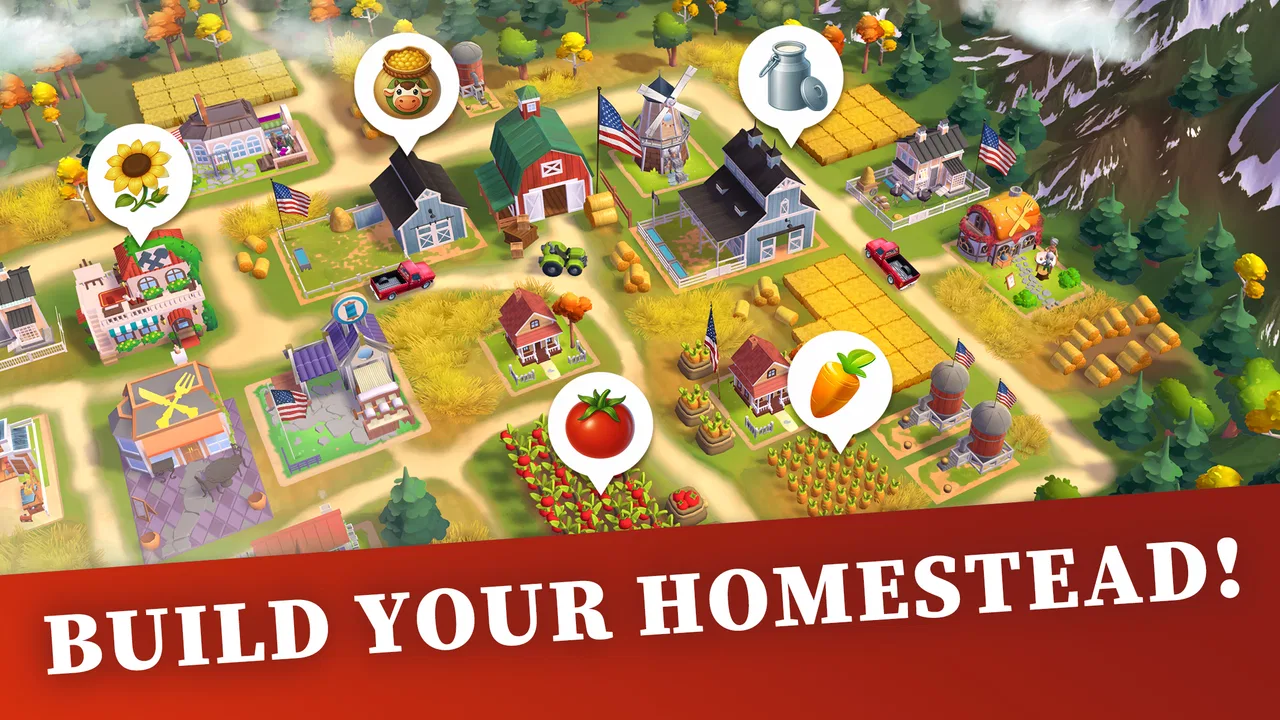
Big Farm Homestead is the kind of farming simulator I can open for a few quiet minutes and still feel that I have moved my little estate forward. I plant, collect, expand, and work through the mystery at the center of the farm rather than simply repeating a decorative building routine. That combination gives the game a clearer purpose than a basic crop-and-cash loop, while its relaxed presentation keeps the experience approachable.
Developed by Goodgame Studios, this free simulation game is aimed at Everyone and is available for Android devices running at least Android 11. It has already passed one million installs, with a 4.7 average from around twenty thousand ratings. Those numbers do not replace personal experience, but they do match my first impression: this is an accessible farm game with a broad audience, a gentle pace, and enough progression to encourage regular visits.
How the homestead feels in everyday play
My usual session starts by checking what is ready rather than immediately spending resources. Harvesting first gives me a clear view of what can be produced next, which buildings need attention, and whether I should save materials for an important upgrade. That simple order matters because the game becomes less satisfying when I tap through tasks without thinking about the next cycle.
You May Also Like

 Blood Strike: 2.5 Anniversary
Blood Strike’s Loadouts Turn Every Drop Into a Tactical Gamble
A close look at Blood Strike’s custom loadouts: how fast access to signature weapons reshapes its battle royale rhythm, rewards preparation, and narrows the gap between fights.

 Pandora - Music & Podcasts
Pandora’s Music Is Easy to Start, but Harder to Recover
Pandora’s strength is its low-effort path from a seed to a station. Its weak spot is how much confidence it asks you to place in connection, setup, and quiet recovery.

 8 Ball Pool
 Is Built on Rivalries, Rematches, and Routine
A close look at the rivalries, rematches, shared routines, and unanswered safety questions that turn a quick pool match into a persistent mobile community.

 Samsung Music
’s Quiet Strength Is Playing What You Already Own
Its reach comes less from spectacle than from dependable access to a personal library. That simplicity is both the app’s strongest retention engine and its ceiling.

 AccuWeather: Weather Radar
AccuWeather Review: A Quick, Clear Forecast for Everyday Decisions
For everyday plans, the best forecast is the one you can understand quickly. AccuWeather makes rain timing, radar, and local conditions easy to act on, with a few trade-offs.

 Hill Climb Racing
Why Hill Climb Racing Still Turns Crashes Into One More Run
A tiny car, a bumpy hill and one more upgrade: Hill Climb Racing keeps resurfacing because its simple chaos makes every near-miss feel personal.
More From Our News Desk
View All News


The central routine is easy to understand. I develop the homestead, grow and collect goods, then use the results to keep the farm moving. The mystery gives those familiar activities a reason to exist. Instead of treating the land as an endless decoration project, I feel as though each improvement contributes to a larger journey.
I particularly like the way this structure suits short visits. If I have only a moment, I can collect finished work and prepare the next step. With more time, I can look at the wider condition of the farm and decide which improvement deserves priority. That makes it suitable for a commute, a coffee break, or an evening session when I want something calmer than a competitive game.
The important habit is to avoid treating every available action as equally urgent. A full harvest may look productive, but the better choice is sometimes to leave a useful production chain ready for the next visit. I found that planning around what I will need next works better than spending everything as soon as it appears.
A practical first-session routine
For a new player, I would begin by learning the relationship between planting, harvesting, and improving the property before worrying about perfect efficiency. The early stages are a good time to notice which actions are quick, which ones ask for patience, and which upgrades open a more comfortable rhythm. Rushing through the opening can make later decisions feel confusing because the farm has grown without a clear plan.
My preferred routine is to collect completed work, check the next available objective, and then choose production that fits the time I expect to be away. If I am putting the phone down for a while, I prepare longer tasks. If I know I will return soon, I choose actions that let me make another useful decision during the next visit.
This is also where the mystery becomes helpful. When I am unsure what to do next, the story direction gives me a reason to explore the current stage instead of endlessly rearranging the farm. Players who enjoy a visible goal will probably appreciate that guidance more than people who want a completely open-ended sandbox.
One small but useful tip is to keep a mental reserve of materials for the next meaningful improvement. It is tempting to spend every reward on appearance or immediate convenience, but a farm that can continue its production cycle feels better than one that looks busy while waiting for basic supplies. I would not call this a strict rule; it is simply the habit that kept my progress from feeling lumpy.
Settings and phone habits worth checking
I would check the game’s available settings before settling into a long-term routine. The most useful settings are the ones that make the experience comfortable on your particular phone: sound levels, notification behavior, and any display or control options that affect how easily you can read and tap the farm. I do not see a reason to leave every alert active if you prefer to manage the homestead on your own schedule.
Notifications can be helpful when they remind you that a task is ready, but they can also turn a relaxing game into a constant interruption. My preference is to keep only reminders that support a routine I actually follow. If I am not going to return during the day, repeated prompts add pressure without improving the farm.
The Android requirement is worth considering before installing. Devices need Android 11 or newer, so owners of older phones should check compatibility first. On a supported device, I would also make sure the game has enough free space and that the phone is not already struggling with background apps. A farming game may look undemanding, but a crowded phone can still make taps, loading, or transitions feel less pleasant.
Sound is another personal choice. I enjoy some atmosphere while managing the property, but I often lower it when playing in public or alongside music. The game works well as a quiet, low-attention activity, so I would not let the audio become a reason to avoid it. Adjusting the phone rather than forcing yourself to play with every effect enabled makes a noticeable difference.
Because this is a free game with in-app purchases ranging from $0.99 to $149.99 per item, I recommend deciding your spending boundary before the farm becomes familiar. I keep the focus on ordinary progression and treat purchases as optional convenience rather than part of the basic routine. That approach makes it easier to judge whether a purchase solves a real annoyance or merely shortens a wait that I could accept.
Patterns that make progress feel faster
The fastest pattern I found is not frantic tapping. It is matching the length of a task to the time until my next visit. Short sessions benefit from quick actions that can be checked again soon, while longer absences are better suited to work that can continue without attention. This sounds obvious, but ignoring it creates empty stretches where the farm is doing nothing useful.
I also try to group decisions. Rather than opening the game repeatedly just to collect one finished item, I return when several actions can be handled together. I inspect the farm, collect what is ready, start the next useful chain, and then leave. This reduces the feeling that the game is demanding constant supervision.
Another effective habit is to choose one improvement goal at a time. I might focus on keeping production moving, preparing for a story objective, or strengthening the farm’s general capacity. Switching priorities every few taps wastes resources and makes it harder to tell whether an upgrade has actually helped.
When I have several rewards available, I do not automatically select the most attractive-looking option. I ask which choice will remove the next bottleneck. If production is waiting for materials, a decorative improvement will not solve the problem. If the farm is already functioning smoothly, a visual change may be exactly what makes the property feel more personal. The right decision depends on what is slowing me down.
Experienced players will probably get the most from a repeatable loop: enter, collect, review the next objective, prepare the appropriate tasks, spend only where the plan requires it, and exit. The value is consistency. Once that loop becomes automatic, the mystery and customization have room to stand out instead of being buried under busywork.
Where the design asks for patience
The relaxed pace is also the game’s main limitation. If you want a simulation where every minute produces dramatic change, this may feel too restrained. Farming games naturally include waiting and repetition, and Big Farm Homestead does not remove that trade-off. I enjoy the pauses when I am playing casually, but I can imagine impatient players finding them restrictive.
The free-to-play structure adds another consideration. Optional purchases can make progress feel more immediate, especially when a task is close to completion. I prefer to play without relying on them, but players who dislike any pressure around spending should be aware of the range of individual purchase prices before committing time to the game.
The story mystery gives the farm a destination, yet it may not satisfy someone looking for a deep, choice-heavy narrative. I see it more as a motivating thread that keeps the agricultural routine pointed somewhere. If your ideal farm game is primarily a creative builder with unlimited freedom, the guided direction may feel like a constraint rather than a benefit.
There is also a difference between a game that rewards planning and one that rewards constant optimization. Big Farm Homestead sits closer to the former. I can improve my routine by choosing sensible task lengths and preserving resources, but I do not think it is designed for players who want a dense spreadsheet of production ratios. For that audience, a more technical management simulator would probably be a better fit.
How it compares with familiar farming alternatives
Compared with a purely decorative homestead game, this one gives me more reason to care about the order of my actions. The mystery provides direction, and the production cycle makes improvements feel earned. The trade-off is that I have less freedom to treat the property as nothing more than a visual canvas.
Compared with a traditional, deeper farming simulation, the experience is easier to pick up and better suited to short mobile sessions. I do not need to plan an entire in-game day before making progress. However, players who want detailed character relationships, extensive exploration, or a highly granular economy may find the design lighter than they prefer.
It also differs from competitive farm games because my enjoyment does not depend on keeping pace with another player. That makes it a calmer choice for someone who wants a private routine. On the other hand, anyone seeking intense social rivalry or leaderboard pressure should look elsewhere rather than expecting the homestead to provide it.
In practical terms, I would recommend it to a player who likes gentle management, visible improvement, and a small narrative question to keep the work meaningful. I would skip it if I wanted immediate action, unlimited creative control, or a completely purchase-free progression model with no temptation to accelerate.
What long-term players should watch
As the farm becomes more developed, the challenge is less about learning the controls and more about maintaining a sensible rhythm. The early excitement of unlocking and improving naturally settles into routine. That is not a flaw, but it means the game’s lasting appeal depends on whether you enjoy returning to a familiar project and making gradual decisions.
I would keep an eye on how often I am opening the game out of interest versus obligation. If the routine still feels satisfying when I have only one small task to handle, the design is working for me. If every visit feels like clearing a list, I would reduce notifications and play less frequently rather than forcing a daily schedule.
Version 1.0.3692 is the current version, and the game was released on June 16, 2025. Those details are useful when checking whether your installation is current, but the more important question is whether the core loop suits your patience. Updates can change balance or presentation over time; the basic decision remains the same: do you enjoy building a farm through repeated, planned visits?
The Everyone age rating makes it an approachable recommendation for a broad household, though I would still explain in-app purchases to younger players and use the device’s purchase controls where appropriate. The calm theme is easy to share, and the mystery gives family members something to discuss, but the best experience comes when spending decisions are understood before play begins.
My verdict after settling into the routine
Big Farm Homestead works best when I treat it as a steady companion rather than a game to finish in one sitting. Its strongest qualities are the approachable farming loop, the homestead-building focus, and the mystery that gives ordinary tasks a sense of direction. I can play for a few minutes, make a useful decision, and leave without feeling that I missed an important action-packed moment.
The game is not ideal for everyone. Its pace may test players who want constant rewards, and the free-to-play purchase range means I would set clear boundaries before getting invested. It also does not replace a deeper farming role-playing game for anyone seeking extensive exploration or complex simulation systems.
For me, the best way to play is simple: adjust interruptions, match task length to my schedule, preserve materials for meaningful improvements, and return with a plan instead of tapping randomly. Those habits make the farm feel more efficient without turning it into work. If that sounds like the kind of quiet progression you enjoy, Big Farm Homestead is an easy game for me to recommend. If you need speed, competition, or complete creative freedom, I would choose a different type of farming experience.
FAQs for Big Farm Homestead
01What is Big Farm Homestead and what can I do in the game?
Big Farm Homestead is a farming simulation game where players manage their own virtual farm. You can plant and harvest crops, raise animals, and build various structures. The game also allows you to interact with neighbors, trade goods, and complete quests to enhance your farm's prosperity. It's designed to provide a rich and engaging farming experience.
02Is Big Farm Homestead free to play?
Yes, Big Farm Homestead is free to download and play. However, it offers in-app purchases that can enhance gameplay. These purchases can provide additional resources, speed up progress, or unlock exclusive items. You can enjoy the game without spending money, but in-app purchases offer added convenience and customization.
03What devices are compatible with Big Farm Homestead?
Big Farm Homestead is available on both Android and iOS platforms. It is compatible with most modern smartphones and tablets. To ensure optimal performance, it's recommended to have the latest operating system updates installed. Check the app store listings for specific device compatibility and requirements.
04Does Big Farm Homestead require an internet connection to play?
Yes, an internet connection is required to play Big Farm Homestead. The game relies on online features such as trading with neighbors, participating in events, and accessing the latest content updates. A stable internet connection will ensure a smooth gaming experience and allow you to fully enjoy all aspects of the game.
05How can I contact support if I encounter issues in Big Farm Homestead?
If you experience any issues while playing Big Farm Homestead, you can contact the support team via the app. Navigate to the settings menu and select 'Help' or 'Support.' There, you'll find options to submit a ticket or access a FAQ section that may resolve your issue. The support team is responsive and ready to assist with any concerns.
Pros
- Engaging storyline keeps players invested.
- Beautiful graphics with vibrant visuals.
- User-friendly interface for easy navigation.
- Regular updates with new content.
- Offline mode available for uninterrupted play.
Cons
- In-app purchases can become costly.
- Requires a stable internet for updates.
- Some tasks can be repetitive.
- Limited customization options.
- Energy system can slow down progress.

Big Farm Homestead
Gallery